
DIY: Ladder Safety and Gutter Cleaning

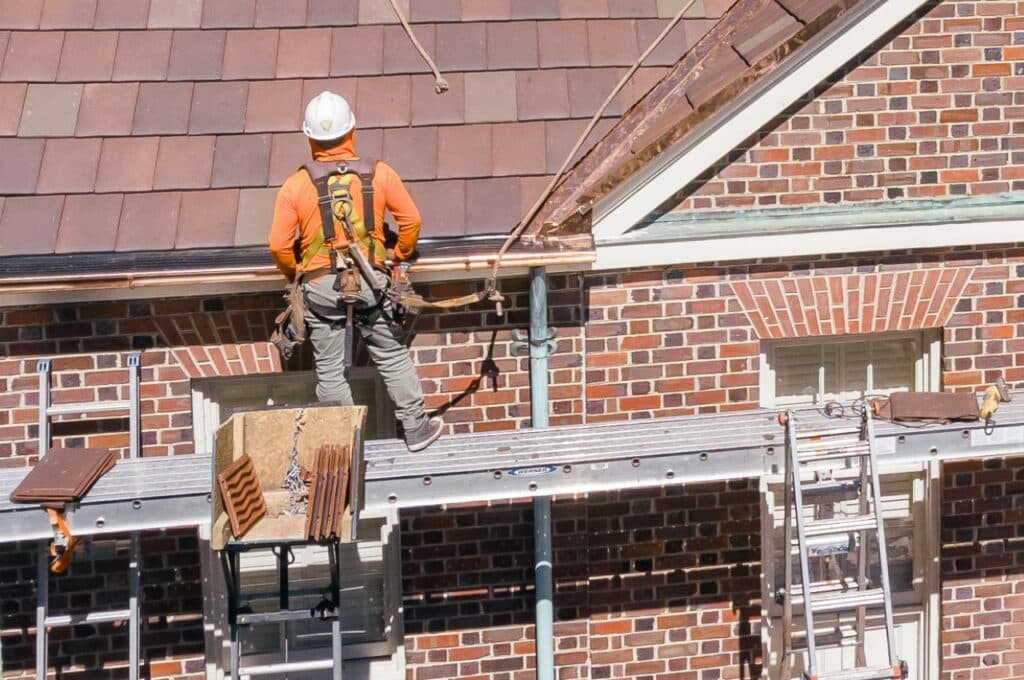
man in safety working on copper gutters with ladder

Experts recommend cleaning your gutters every spring and fall, but if there are pine trees near your home you may need to check on them every three months. Between leaves, our lovely Carolina pines, and other debris, gutters can easily become messy and clogged.

The actual cleaning of the gutters is not a very difficult process. Whether it’s cleaning by hand, hose, wand, or blower there are a number of effective methods. Whatever you choose, we have a few tips for you. Here are a few things to have on hand before you get started:

  1. Gloves
  2. Eye protection
  3. Trash bag
  4. Ladder
  5. Water hose

Cleaning by hand is the most common method that we see used by homeowners. Be sure to have gloves on, and remove the debris tossing it onto the ground or into a trash bag. If you do toss it onto the ground be sure to collect it and throw it away afterward so it does not attract insects. If there are clogs or dirt that you think rainwater will not be able to remove, a hose can also be used to give the gutters a final rinse-out. Not too bad right? However, for most of us our gutters are not at ground level, so a ladder is essential.

Being a roofing company, we take ladder safety very seriously and like to consider ourselves experts on the subject. Here are a few tips and important things to know about ladder safety.

  1. We recommend using an aluminum ladder with stand-offs. Stand-offs go on either side of the ladder and provide added stability as well as prevent any damage that the ladder could cause to your gutters or shingles.
  2. After setting up the latter make sure you kick the feet out if you’re on sod. This is an important step when you are working in an area with the softer ground like sod or grass. If you are working on the concrete, then it is best practice to leave the feet as they originally were with the flat side down.
  3. Before you hop on the ladder, be sure to have a friend hold the ladder at the bottom as you climb. Once your ladder is set up properly, you can focus on safe climbing. It is best to climb starting with one foot, followed by the opposite hand, then the other foot followed by the other hand. While you are on the ladder, always maintain at least three points of contact.

As with any home improvement project, stay within your comfort zone. If you do not feel comfortable with this project, we recommend seeking out a licensed gutter cleaning contractor. Anytime we are on a job site, we wear our full safety gear. Although it is not essential for typical home projects, we recommend always taking every step possible to be safe.

Gutter cleaning can be a time-consuming chore, so many homeowners purchase gutter guards as an alternative. They have a net-like design to allow water to flow through while still preventing debris from getting into your gutters. If you are interested in learning more about Rain Drop Gutter Guards, contact us today!

Waterhead

A box-shaped component that connects scuppers to downspouts, helping control the flow of roof runoff and avoiding unsightly cascades. Waterheads are also called conductor heads or rainheads.

Expansion Joints

Flexible joints built into a roof system that absorb movement from expansion and contraction. They prevent cracking and leaks at connections between different parts of your roof assembly.

Drip Edge

An L-shaped piece of roof edge flashing that helps rainwater flow off the roof and away from the fascia boards. It prevents water from seeping under shingles or other roofing materials, protecting the roof deck from rot.

Capillary Action

The process where water moves into tiny gaps or along narrow spaces, often against gravity, because of surface tension. In roofing, it can draw water into seams or cut edges, leading to hidden leaks and damage.

Membrane

The waterproof layer in a roofing system that protects the building from water intrusion and reflects sunlight, lowering energy costs. It’s usually the top layer of the roofing system and can be made of materials like TPO, PVC, EPDM, or modified bitumen.

Heat welded thermoplastic membrane

A type of white single-ply roofing membrane that’s sealed at the seams using hot air, creating a waterproof layer over the roof. It’s commonly used on flat or low-slope commercial buildings, since these roofs need to most protection from water infiltration.

EPDM (ethylene propylene diene monomer)

A black, gray or white rubber roofing membrane known for its long lifespan. It’s commonly used on flat or low-slope buildings and is typically glued down, mechanically fastened or ballasted, not heat-welded.

PVC (polyvinyl chloride)

A high-end type of heat-welded thermoplastic membrane that stands up well to oils and chemicals. It’s ideal for restaurants or industrial buildings for its extra resistance, though it usually costs more.

TPO (thermoplastic olefin)

A durable type of heat-welded thermoplastic membrane that reflects sunlight and helps reduce cooling costs. It’s a cost-effective option for flat roofs but may not perform as well as PVC in harsh environments.

End cap

A metal cap that seals the open end of gutters, flashings, or panels. End caps prevent water from spilling and protect roof edges from corrosion or leaks.

Soldered joint

A watertight joint created by joining metal roofing or flashing components together. Soldered joints provide long-lasting, durable seals against water infiltration.

Parapet wall

The short wall that extends above the roofline, often around the roof’s edge, to provide safety, block wind, and in some cases help manage water drainage. In roofing, parapet walls are usually capped with coping to keep water from seeping into the wall structure.

Retro drain

A roof drain retrofit designed to fit inside existing piping without major demolition. Retro drains are cost-effective solutions for improving drainage on older roofs.