
 BACK TO BLOG
 Roof Coping: Everything You Need to Know
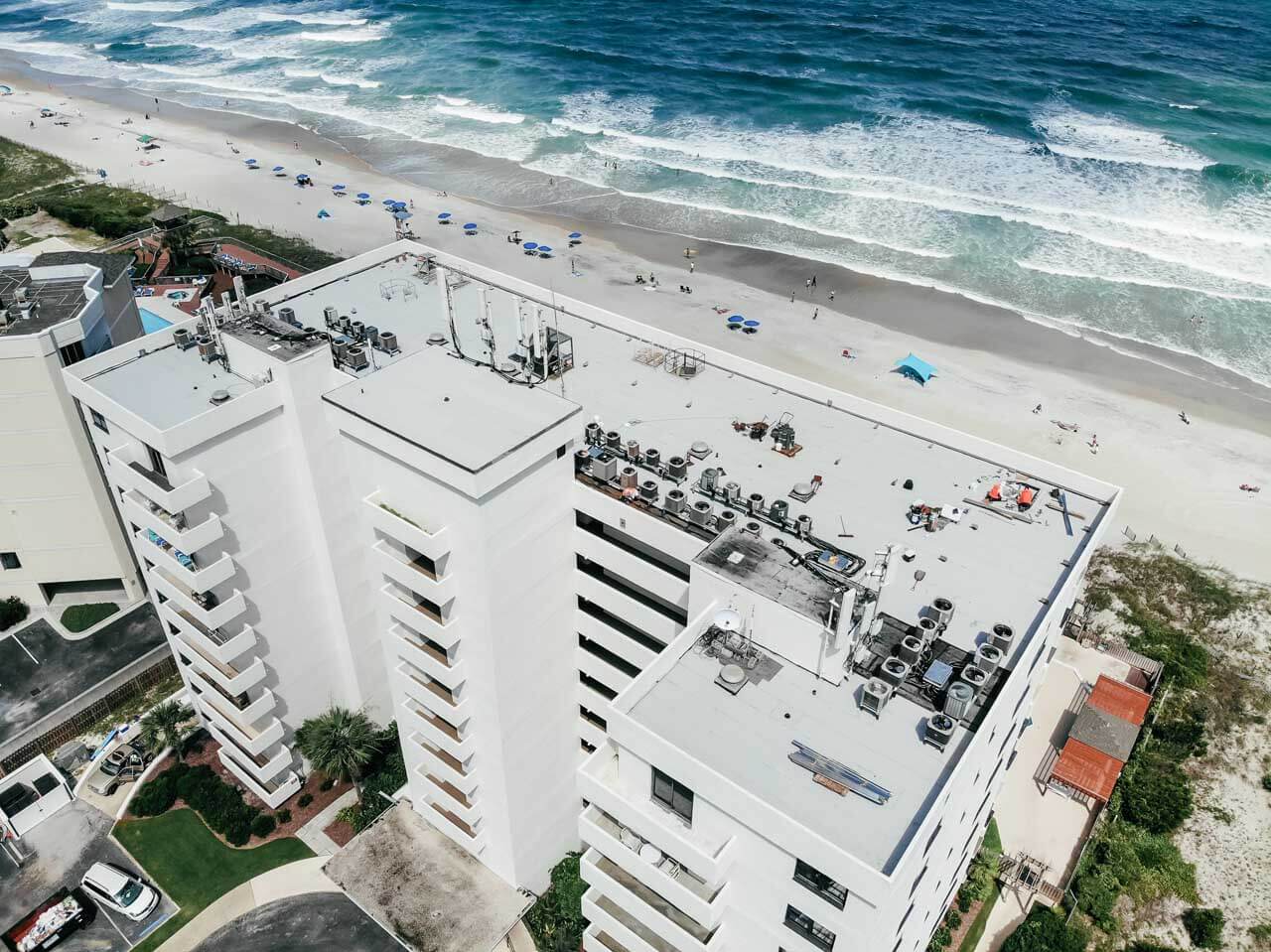
If your property has a flat roof (or even certain forms of sloped roof), a parapet wall probably sits atop it. Parapet walls are the short protective walls around the perimeter of your low-slope roof, both preventing falls and concealing unsightly installations like HVAC behind it.
However, with too much exposure to the elements, parapet walls face infiltration from rainwater, causing efflorescence (don’t worry, we’ll get to it) and structural damage from water expansion. So, how can this problem be solved?
With roof coping! Unless you’re an experienced facilities manager, you’ve likely never heard of this humble feature, but it’s crucial to the functionality of your parapet walls. In this article, we’ll cover what roof coping is and why it matters, equipping you to make the decisions that matter about your commercial roofing system.
Quick Answer
Roof coping is the protective “cap” that sits on top of a parapet wall on flat roofs. By shedding water and sealing corners and miters, it prevents leaks, freeze-thaw damage, and white salt staining known as efflorescence. Coping is typically metal, copper, stone, terracotta, or concrete. Quality roof coping expands your roof’s lifespan while improving its appearance.
Point 1: What Is Roof Coping and Why Does It Matter?
Essentially, roof coping is a protective “cap” covering the top of a parapet wall. Some other names for this feature include the following (warning: there are a lot):
- Wall coping
- Wall cap
- Wall capping
- Wall cover
- Coping cap
- Roof coping cap
- Parapet capping
- Parapet roof coping
- Etc.
Without roof coping, water would infiltrate the parapet wall, causing leaks and structural damage that would require costly repairs. Coping for roof assemblies provides:
- Waterproofing: Stops water from entering porous walls, preventing structural damage caused by water expanding when frozen.
- Wind resistance: Helps reduce wind uplift around your roof’s perimeter by securing the top of the parapet wall, keeping masonry from falling and hurting someone (all it takes is one loose brick being dislodged during high wind to cause serious damage).
- UV protection: Creates a barrier between the parapet wall and UV rays, vastly reducing the damage caused by ultraviolet radiation.
- Aesthetic finish: Provides a clean, professional appearance to your roof from ground-level view (note: some people choose high-end coping materials like copper for added curb appeal).
- Longevity: Protects against freeze-thaw cycles and mechanical weathering, slowing wear-and-tear over time.
All of these roles come together to reduce the frequency of problems with your parapet wall and broader roofing system, saving you money in the long run.
Point 2: Types of Roof Coping Materials
There are a variety of different materials used to make roof coping, all having their own benefits and drawbacks. Let’s take a look at the most common options.
Basic Metal Coping
Fabricated from galvanized steel, aluminum, or stainless steel, standard metal coping is the most common form of roof coping on the market. Usually, it’s custom-bent to match your parapet wall’s slope and drip edges.
Since metal coping isn’t prone to cracking or weathering over time like terracotta or concrete, it better resists rain, wind, and cold weather, giving it a lifespan of around 40-70 years. You can improve this durability with Kynar, a popular protective coating for metal roof materials.
However, extreme temperature fluctuations can cause metal parapet coping to undergo thermal expansion or contraction, meaning that it must be installed with gasketed fasteners and expansion joints. It’s also more expensive than some other coping options, costing around $20-$50 per linear foot depending on the finish and type of metal.
Copper Coping
Copper is a premium coping material prized for its natural beauty, making it best for historical properties and businesses that frequently receive customers, like restaurants and stores. A lot of its aesthetic appeal comes from the patina it develops over time, adding both a unique green hue and extra protection from the elements.
In part due to its patina, copper is naturally durable, resisting corrosion and debris damage over the decades. As a consequence, copper coping can last between 70-100 years (or even longer with proper maintenance). However, that long lifespan makes the metal pretty expensive, costing around $35-$75 per linear foot.
Terracotta or Camelback Coping
Terracotta is a traditional clay-based coping material found most commonly on older brick buildings. It’s usually installed over a mortar bed, then filled at joints. Despite mainly receiving praise for its unique appearance, well-maintained terracotta also sports impressive durability, lasting around 50-100+ years.
Terracotta coping’s price tag is in the middle of the pack, with the material costing around $20-$40 per linear foot. This lower price is largely because of its vulnerability to cracking under cold and wet conditions, though the coping can still be protected by certain waterproof sealants.
One particularly popular form of terracotta coping is camelback coping, which stands out due to the round hump running along its center (hence the name). Because of its unique performance, camelback and other forms of terracotta coping are increasingly protected by local historic preservation laws throughout the Southeast, especially as replacing terracotta with metal coping on historic buildings has become more common over time.
Stone Coping
Like copper and terracotta, stone coping stands out mainly for its aesthetic charm, giving character to commercial properties that adds to their resale value. However, it also sports an impressive lifespan, lasting up to 100 years with proper care.
However, stone isn’t without its drawbacks. It’s heavy and difficult to install, both of which tend to drive up prices. Because of that, stone coping tends to cost around $30-$70 per linear foot, depending on the type of stone used.
Concrete Coping
Concrete is the most affordable coping material on the market, costing around $10-$30 per linear foot. Because of that, it’s best for budget-conscious commercial projects, as well as modern buildings that can better make use of its unique aesthetics (especially since most people don’t consider concrete coping to be as visually appealing as the other common coping materials).
Of course, with a lower price tag comes lower performance, at least compared to the other materials we’ve discussed. Concrete coping requires more maintenance and tends to last around 50 years.
This is mainly due to its vulnerability to surface erosion over time, though certain finishes can make it more durable. Still, if you prioritize affordability, concrete may be the perfect option for you, especially if you don’t plan on using your current property for more than a few decades.
Types of Coping Materials: What You Need to Consider
If you’re trying to decide between these coping materials, consider the following:
- Your Budget: If you prioritize getting the most out of your money in the short-term, concrete, terracotta, or metal coping is best for you. However, if you can handle high upfront costs and seek long-term savings, more expensive options like copper and stone are a good fit.
- Your Property Type: If your property is customer-facing, such as a restaurant or store, you may benefit from more aesthetic options like terracotta, stone, and copper. On the other hand, purely production-focused properties like factories may benefit more from performance options like concrete and metal.
- Your Future Plans: If your business expects to remain in the same building in the long-term, durable materials like copper and stone are best. Otherwise, concrete and metal offer strong short-term value with lower upfront costs.
Use this table to help compare the five materials we’ve discussed:
| Material | Price Range (Per Linear Foot) | Typical Lifespan | Best For |
|---|---|---|---|
| Basic Metal | $20 – $50 | 40 – 70 years | Industrial and commercial buildings |
| Copper | $35 – $75 | 70 – 100+ years | Historic or high-end properties |
| Terracotta | $20 – $40 | 50 – 100+ years | Older or historic brick buildings; customer-facing businesses |
| Stone | $30 – $70 | Up to 100 years | Luxury commercial or institutional properties |
| Concrete | $10 – $30 | Around 50 years | Budget-conscious projects or modern designs |
Point 3: The Role of Miters in Roof Coping
On most parapet walls, coping runs along corners, where different coping legs must meet. This is where miters come in. A miter is a coping detail where two roof or parapet wall legs meet, typically at a 90° angle.
Instead of overlapping pieces or leaving a gap, coping is cut and joined at an angle, which allows the coping to be visually continuous and ensures every part of the wall is protected equally.
To be successful, a miter must do three things:
- maintain water-tight continuity around corners,
- prevent weak points where water could enter, and
- ensure a professional, finished look.
High-quality miters should be mechanically fastened, sealed, and sometimes soldered (especially in the case of copper) in order to create a waterproof seal. Poorly executed miters are one of the most common failure points in coping assemblies, causing water damage to the parapet wall.
Point 4: Roof Coping vs. Parapet Cap Flashing: What’s the Difference?
Sometimes, people confuse coping with wall flashing or counter flashing. That’s because both of these are waterproofing measures meant to prevent structural damage. However, they do so in different places and in different ways.
We’ve already established that coping sits atop a parapet wall, protecting it from water. However, wall flashing (such as through-wall flashing or reglet flashing) sits within or behind a wall, most often at transitional points where water frequently intrudes.
Of course, though different, these two systems often work together: while coping sheds water off the top, flashing helps any water that does infiltrate the wall escape. Because of that, both are crucial parts of any parapet wall waterproofing system.
Point 5: Common Problems with Roof Coping
Like any part of your roof, coping can fail due to improper installation, poor maintenance, or simple bad luck. Here are some of the most common issues you might face:
- Loose or missing coping sections due to wind uplift.
- Leaking joints at seams or corners, especially if miters aren’t functioning properly.
- Corrosion on metal coping if coatings are damaged.
- Cracks in terracotta coping caused by cold temperatures and moisture.
The best way to combat these problems before they become serious is to have your roof inspected 1-2 times a year by a licensed commercial roofing contractor like Baker Roofing Company.
Point 6: Efflorescence: Why White Stains Form on Walls Below Coping
There’s one more frequent problem we see with roof coping, complex enough to warrant its own section. Efflorescence is a white, chalky buildup on a parapet wall that signals water intrusion. It’s caused when water infiltrates the wall (often from poorly sealed coping or flashing), dissolves natural salts in the masonry, and then evaporates. This process leaves those salts on the wall’s surface, causing the white buildup you see.
Beyond being unsightly, efflorescence is a problem because the water infiltration that creates it can cause structural damage within your parapet wall, especially if it freezes and expands rather than exiting. Luckily, well-maintained coping can stop this process in its tracks by preventing water from infiltrating your parapet wall in the first place.
If you notice efflorescence on your parapet wall, follow these three steps:
- Clean affected areas with a mild masonry cleaner.
- Inspect coping for cracks, open seams, or damaged sealant.
- Consider contacting a roofing contractor to reseal or replace your coping if you notice more efflorescence buildup.
Point 7: Flat Roof Coping: Special Considerations
Flat roofs almost always need parapet walls, and those walls usually have coping. For a flat roof coping system, keep these tips in mind:
- Expansion joints in metal coping are even more critical than usual because flat roofs experience wide temperature swings. These variations are caused by more direct sun exposure and less insulation than is faced by sloped roofs, making expansion joints crucial.
- Membrane systems can integrate with your coping. For example, on an EPDM roof, uncured flashing is used at coping transitions.
- Drainage must be designed with scuppers and roof drains to prevent ponding at parapet edges, causing a risk of water infiltration against which coping can’t protect.
Remember that coping is your flat roof’s first line of defense against leaks and structural damage, meaning that properly installing and maintaining coping should be at the top of your list of roofing priorities.
Point 8: Historic and Architectural Considerations
If your property is in a historic neighborhood or has historic protections itself, you should consider how that relates to coping. For instance, many older brick buildings feature terracotta coping. If you decide you want to replace this with metal, you may need permission from your preservation board.
Coping can also help maintain your property’s unique historical look. Some metal coping can be custom-fabricated to mimic stone or terracotta profiles to pay homage to the building’s original time period.
On a similar note, copper coping caps can add historical character to your roof, especially as they patina over time. By selecting materials that respect your building’s original design, you can ensure your roof remains both historically authentic and structurally protected as the years keep coming.
Point 9: Why Professional Installation Matters
Of course, you understand by now how integrated each component of your roofing system is. Because of that, coping failure can disrupt your entire property’s drainage system, risking costly structural damage. That’s why professional installation is so important; for example, here are some of the more complicated aspects of coping that DIY installation may fail to consider:
- Correct gauge metal and fastening spacing
- Proper slope and drip edge fabrication
- Integration with membranes on low-slope and flat roofs
- Expansion joint placement
- Coordination with other systems like HVAC penetrations, drains, and lightning protection
Unless you’re a roofing expert who can account for all of these factors in your DIY installation, consider working with a licensed local roofing contractor like Baker Roofing.
Frequently Asked Questions (FAQs)
Roof coping refers to the protective cover placed on top of parapets or retaining walls. It shields masonry and underlying materials from rainwater, snow, and UV damage, helping extend the lifespan of your roofing system.
Metal roof coping is a durable and low-maintenance coping option fabricated from aluminum or steel. It’s custom-bent to fit your parapet walls and is affordable compared to higher-end materials like copper and stone.
Coping is sloped slightly inward or outward, depending on design intent. Outward slopes direct water away from the wall face, while inward slopes drain water back to the roof membrane and scuppers. Either way, the goal is to control runoff and avoid wall staining or efflorescence.
Sealant is applied at coping joints and corners (called miters) to prevent water infiltration. Over time, sealant can degrade from UV exposure and should be inspected and replaced during routine maintenance.
A miter is a corner joint where two coping sections meet at an angle, most commonly 90 degrees. Miters are fabricated to match the coping profile and are sealed or soldered for continuous waterproof protection.
Efflorescence forms when water seeps into masonry walls, dissolving salts that later crystallize on the surface as white streaks. Properly sealed coping and functional weep holes prevent this by keeping moisture out of the wall system.
When properly installed and maintained, metal roof coping can last 40-70 years or longer. Copper coping can exceed that lifespan thanks to its corrosion resistance and natural patina.
Coping covers the top of the wall to keep water out, while flashing is installed at transition points inside the wall to guide trapped water back out. Both work together to create a watertight roof assembly.
Final Thoughts
Roof coping may not get the same attention as shingles or skylights, but it plays a vital role in roof performance. Building owners should treat coping as a priority in roof installation and maintenance. So, if you’re asking, “What is roof coping?”, now you know: it’s your building’s crown, and it deserves expert attention.
Baker Roofing: Commercial Roofing Services Throughout the Southeast
Are you looking for roof coping installation or maintenance services near you? For over 110 years, Baker Roofing Company has provided premium commercial roofing services across the American Southeast. We provide quality work that only a century of experience can guarantee. So, if you want peace of mind about your property’s roof, schedule a free estimate using the button below.
Related Insights
 Roofing Insights
Metal Roof Decking: What It Is and How to Choose It

Metal roof decking is the corrugated, ribbed steel panel system installed as the structural base beneath a commercial roof system. The deck carries the…
 Industry Insights
Flat Roof Skylights: A Design and Maintenance Guide
A flat roof skylight is a roof window designed to bring natural light into buildings with flat or low slope roofing systems. Installed either…
 Industry Insights
What Is Roof Flashing? 7 Tips to Keep Water Out
Roof flashing is the metal or membrane material that seals the gaps and transitions on a roof, directing water away from the joints, seams,…