In the Southeast, heavy downpours and hurricanes are normal, meaning that your building’s flat roof drainage system must do far more than move water around. Because of that, low slope roof systems must protect the membrane and reduce leak risk so the roof can reach its full service life.
To that end, this guide walks through how flat roof drainage works, the types of systems commercial buildings rely on, and what property managers should watch for to stay ahead of costly failures, all so that you can maximize your investment in your commercial property.
Table of Contents
Quick Answer
A flat roof drainage system moves water off your roof using four features: internal drains, scuppers, gutters, and drain sumps. These components work together so water flows toward designated flat roof drainage outlets, which prevents ponding and relieves the structural load your roof has to bear.
In the Southeast, proper drainage is essential because heavy rainfall and severe storms can overwhelm poorly maintained systems, especially on buildings along the coast.
Looking for Flat Roof Drainage Services?
How Flat Roof Drainage Works
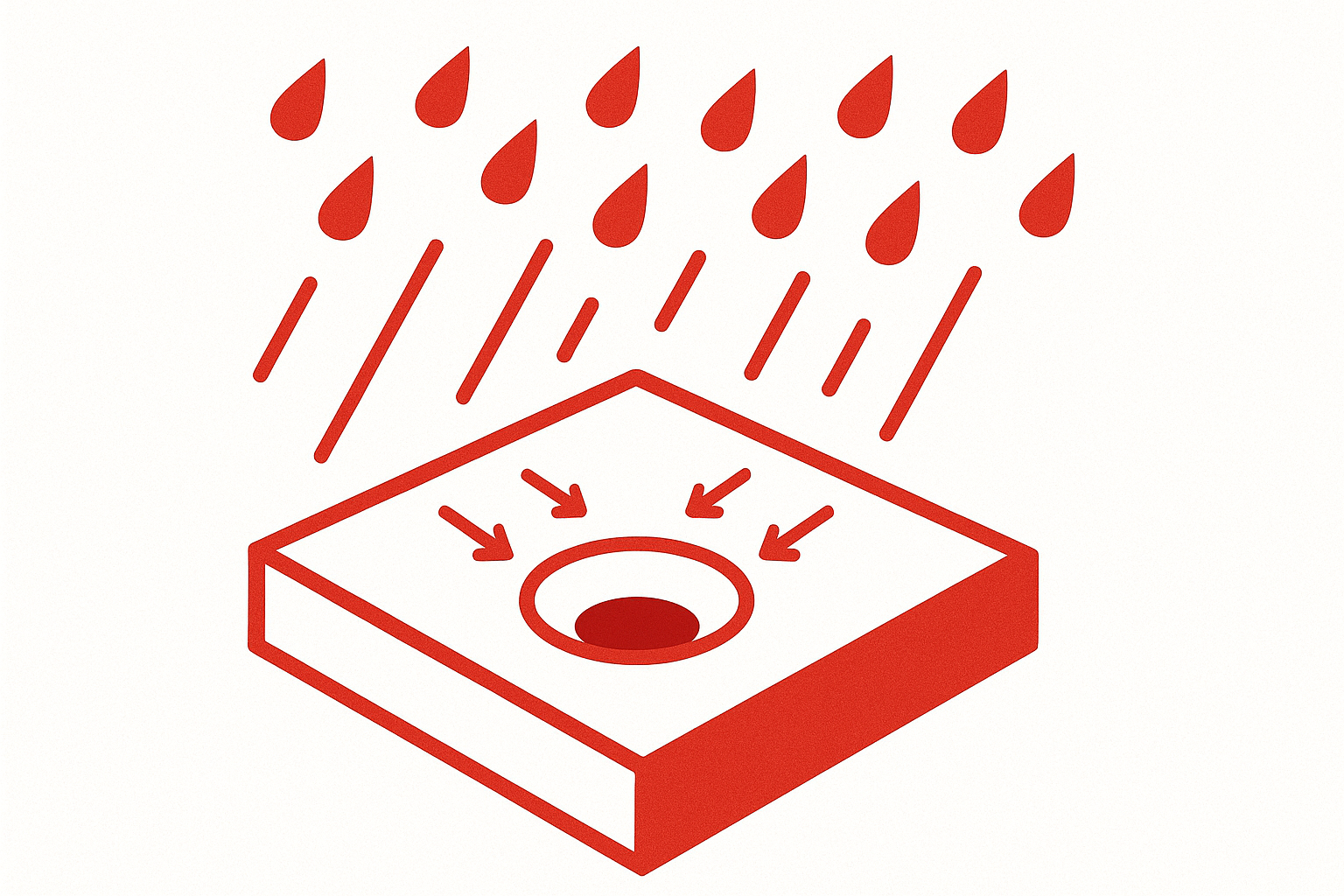
Despite the name, flat roofs always include some slope created by tapered insulation or lightweight insulating concrete. This slight pitch must be at least 1/4″ rise per foot of run, which is just enough to direct water to:
- Internal drains
- Drain sumps (often working alongside tapered insulation)
- Flat roof scuppers
- Flat roof gutters
When designed correctly, water never lingers for more than 24–48 hours and never exceeds the load the structure was engineered to bear.
Top 4 Most Common Flat Roof Drainage Features
Proper drainage relies on several components working together, and understanding these features makes it easier to diagnose problems before they turn into costly failures.
1. Internal Drains
These drains sit at the low points of a commercial roof in the same way your shower drain sits at the lowest point of the ceramic floor. Instead of draining water directly off the roof, they usually connect into the building’s plumbing system.
Internal drains are important because:
- Drainage piping that’s hidden within the building protects against freeze–thaw cycles, which can cause early pipe failure.
- They’re ideal for large commercial roofs where perimeter drainage isn’t enough.
- For buildings with internal drains, they’re responsible for continuously pulling the majority of stormwater off the roof, while other drainage components serve as backups or secondary relief paths.
Some Notes on Retrofit Drains
Retrofit drains (or retro drains) are replacement drains installed into existing drain bodies during reroofs or repairs, which allow contractors to enhance drainage without opening up the entire plumbing system.
Believe it or not, as much as 75% of retrofit drains are fitted incorrectly. That usually means water backs up inside the assembly instead of flowing out as designed, which can cause interior staining or mold growth behind walls. What’s even worse is that since this all takes place on your roof, you’re unlikely to notice the issue until the damage to your interior is already done.
Because of this, every retro drain should undergo staged water testing with drain balls to confirm that water leaves the roof the way it should. Without this confirmation, even a minor storm can overwhelm the drainage system and lead to preventable leaks.
Southeast factor: Hurricanes can overwhelm internal drains if debris collects under the membrane, since the debris acts like a speed bump that blocks water’s flow toward the drain.
2. Drain Sumps and Tapered Insulation
Drain sumps are depressed areas around internal drains that help capture water efficiently and move it downward. By lowering the membrane around the drain bowl, they create a small “collection pocket” that guides water into the inlet faster and prevents it from spreading across the roof surface during heavy storms.
They often come hand-in-hand with tapered insulation, which is a sloped, lightweight insulation system made from polyisocyanurate, or PIR. Instead of relying on the roof structure itself to create slope, contractors sometimes install tapered insulation to guide water toward drains without adding significant weight to the roof. Lightweight concrete can be used for this same purpose.
To clarify, a sump is the depression that drains water into the internal drain, while tapered insulation creates the slope that directs water toward the sump. Every internal drain should sit inside a properly formed sump; that way, water will flow directly into the inlet rather than spreading across the membrane.
Southeast factor: Even small depressions without drains at their center can turn into significant ponding areas after a single hurricane-strength rain event.
3. Flat Roof Scuppers
Scuppers are openings through parapet walls that allow water to exit the roof into downspouts or conductor heads. Think of those gargoyle features on medieval cathedrals that spit water out when it rains—those are scuppers!
There’s a difference between primary and secondary scuppers:
- Primary scuppers sit at roof level.
- Secondary (or overflow) scuppers sit roughly 2-4 inches higher, acting as an emergency exit point if primary drainage is blocked.
Scuppers often fail because:
- Debris and mud clog openings.
- Conductor heads, the additional features that direct water from scuppers into downspouts, may overflow during extreme storms.
- Poor flashing around scuppers leads to leaks and mold growth inside parapet walls.
Southeast factor: Because coastal rainfall is increasingly intense, overflow scuppers are essential. In fact, many insurance carriers now require them.
4. Flat Roof Gutters
Commercial flat roofs often use either external or built-in gutters, both of which are meant to drain water at the roof’s edge. External flat roof guttershang along the exterior edge and areeasy to access for cleaning and repair, making them lower-risk and more straightforward to maintain.
Built-in gutters, on the other hand, are far more leak-prone and difficult to fix than external gutters. This is because they’re integrated into the roof assembly (either the roof itself or the parapet wall), meaning any failure becomes a direct path into the building.
However, these gutters offer better aestheticsthan their external counterparts simply by not being visible, so they’re your best option if style is just as big a priority for you as successful drainage. For instance, commercial buildings stores and restaurants frequently receive customers, so they may be able to justify higher maintenanceexpenses in order to boost look and feel.
Repairing Built-In Gutters
Because built-in gutters sit inside the roof assembly, the best repair method is a fully fabricated metal insert, usually made from stainless steel or copper, that’s soldered with watertight end caps and properly sized conductor heads.
Without metal insert repairs, the membrane lining will eventually shrink and deform, creating gaps that let water bypass the gutter channel and leak directly into the roof assembly. There, it can travel unseen and cause significant interior damage.
Quality metal gutter inserts run about $100 to $150 per linear foot. That price point is a product of both the metal’s cost and the skilled labor required to fabricate conductor heads and end caps that won’t separate under heavy Southeastern rainfall.
Southeast factor: High humidity accelerates corrosion in poorly flashedbuilt-in gutters.
The Dangers of Poor Flat Roof Drainage
When drainage on a flat roof breaks down, the consequences reach far beyond surface-level puddles. Still, each issue that follows, whether exterior or interior, stems from water remainingwhere it shouldn’t. Here are the most common issues that come from drainage failure:
1. Accelerated Membrane Degradation
When water remains on the roof for more than 48 hours, it begins to change the chemistry and physical behavior of the roof membrane. Ponding water:
- Prevents proper drying,
- Attracts debris, and
- Increases the rate of UV-related aging.
Different membranes respond to ponding in equally different ways:
- Heat-welded thermoplastics (TPO/PVC): These membranes rely on plasticizers (PVC) and stabilizers (TPO)to maintain flexibility and avoid UV degradation. Prolonged ponding accelerates the migration of these chemicals, which causes brittleness and eventual cracking. As plasticizers and stabilizers escape the sheet, welds may become more rigid and details more vulnerable to movement.
- EPDM:EPDM naturally shrinks over time, often around 3% over its service life. Ponding amplifies this issue at angle changes and transition points. As the membrane pulls back, it exposes fasteners and increases the chance of openings around penetrations.
Additionally, all membrane types experience some level of microbial growth and debris accumulationwhen water stagnates. These environmental factors reduce reflectivity, which decreases your building’s energy efficiency and, as a consequence, raises HVAC costs.
2. Added Structural Load
Beyond aging a roof, standing water adds weight the structure may not have been designed to carry. Remember that water weighs 5.2 poundsper square foot per inch of depth. That means even a small depression spread across a wide area can introduce thousands of poundsof extra load to your decking.
Also note that accumulated water may cause:
- Cracking in lightweight concrete toppings
- Roof decking (i.e., structural support) degradation
- Progressive sagging that creates new ponding areas, compounding the issue over time
In extreme storm events, such as those common in the Southeast, poor drainage can quickly escalate from a maintenance problem to a structural emergency.
3. Flashing and Edge Metal Failure
Flashingis a waterproofing material installed at roof edges, walls, joints, and penetrations (like chimneys) to direct water away from vulnerable transitions and prevent leaks. When water backs up against vertical surfaces,these featuresare subjected to conditions they were never meant to handle.
Common Failure Points
It’s common for water buildup to cause flashing failure around:
- Scuppers: If scuppers clog or are undersized, water rises against the wall flashing. Hydrostatic pressure then forces water into tiny gaps behind the membrane or metal.
- Wall flashings: Persistent moisture degrades protective sealants and encourages capillary action (i.e., spreading water) behind flashing.
- Edge metals: Incorrectly installed drip edges (flashing along the side of the roof) lose their ability to shed water cleanly.
Once water infiltrates these assemblies, it often remains trapped, gradually rusting fasteners and accelerating failure at the roof’s perimeter.
4. Hidden Interior Damage
Drainage failures cause problems far from the point of entry. Roof leaks rarely appear directly below the defect; rather, they often travel. Interior damagefrequently occurs without detection because:
- Clogged drainsforce water to seek unintended pathways, sometimes entering around penetrations or expansion joints (i.e., joints that absorb building movement so the membrane doesn’t tear or split).
- Overflowing scupperspush water down parapet walls, allowing it to saturate masonry or insulation before a stain ever appears.
- Built-in guttersthat leak at seams or outlets allow water to migrate into wall cavities, contributing to mold growth for weeks or months before discovery.
- Water can wick (or move) horizontallyacross insulation or decking, making the origin of the leak difficult to pinpoint without lots of invasive testing.
By the time occupants report interior staining, the roofing system, and everything below it, may have already suffered extensive deterioration.
Flat Roof Drainage Maintenance and Damage Prevention
Preventing these drainage issues isn’t complicated, but it does require consistency. Following the maintenance and design practices below dramatically reduces the likelihood of leaks and ponding.
- Always maintain primary and secondary drainage: Both are required to prevent catastrophic water accumulation during Southeastern hurricane season.
- Inspect drains at least twice a year: This is usually done once in the spring, then again in the fall.
- Test retro drains thoroughly: They must be water-tested at multiple points to validate performance. Your roofing contractor should handle this, but you can ask to ensure they completed this step.
- Address ponding ASAP:If you can’t add drains, the roof may require a tapered redesign or, in severe cases, a full reroof.
Applying these habits year-round keeps your drainage system performing as intended, especially in the Southeast where severe rainfall tests roofs more aggressively than in most regions.
Frequently Asked Questions (FAQs)
Flat roofs drain water using a subtle slopecreated throughtapered insulation or lightweight concrete. This pitch directs the water into drains, scuppers, or gutters. Internal drains handle primary flow, while scuppers usually act as emergency overflow routes.
Most commercial roofs use tapered insulation, engineered to create a 1/4" per foot slopetoward drain sumps. You can also pour lightweight concrete to achieve the same effect. However, these strategies only displace water and cannot correct major structural depressions without installing new drains or redesigning the system altogether.
Neither is universally better, sincethey perform different roles. Internal drainshandle everyday stormwater and connect to plumbing, while scuppersprovide overflow protection and prevent catastrophic loading if drains clog. Most commercial buildings need both to drain water properly.
The purpose of flat roof gutters is to drain water at the roof’s edge. Because of that, many roofs need them, especially when they lack parapet walls. But built-in gutters carry high riskof leaks unless installed with proper metal inserts and soldered waterheads.
Common problems causing standing water includeimproper slope, clogged drains, shrinking or aged membranes, depressions in lightweight concrete, and undersized drainage outlets. If standing water remainslonger than 48 hours, your building may need a drainage redesign or additionaldrains.
Final Thoughts
Flat roof drainage is one of the most overlooked but nonetheless important parts of a commercial roofing system. In the Southeast, where rainfall intensity and storm frequency create extreme water loads, drainage failures can quickly turn into persistent leaks and costly interior repairs.
The good news is that with proper drain design, sump installation, scupper placement, and gutter use, your roof can shed water efficientlyfor years. But when drains are undersized or paired with inadequate slope, the system becomes vulnerable fast.
Need an Expert Assessment of Your Flat Roof Drainage?
Baker Roofing Company has more than 110 yearsof experience installing and maintaining commercial flat roof drainage systems across the Southeast. Whether you’re dealing with ponding water, leaks around scuppers, clogged drains, or a built-in gutter that never seems to stop leaking, we can help give you peace of mind.
Use the button below to contact our commercial roofing team before hurricane season and get a free estimatefor your roofing project.
More Information on Flat Roofing