Up in the Air: Alex’s Path to the Roofing Industry

Man infront of a ladder and white truck

From reading flight maps to warranty specs, Alex has had one of the most shocking career shifts we've heard at Baker Roofing! Learn more about our own "Maverick" and his journey from being a pilot to roofing below.

Meet Alex Hephner, a participant in our Construction Management Program currently completing Phase 2 of his training: pre-construction and submittals! For National Roofing Week, we asked Alex to share about his experience making the transition from aviation to roofing.
Man sitting at desk working on a computer

What has the majority of your professional experience been in up to this point?

The majority of my professional experience has been in aviation. I did work with FedEx Freight for a long time before flying but it was more of a part time job while in school. With aviation, I was more into the teaching side of the industry. I was a flight instructor for a long time and then began managing one of the flight school’s academies. I was also able to be checked out with the FAA as a Check Instructor, which gave me the authority to issue pilot certificates and administer check rides. I currently still hold all my ratings with 2200 hours of flight time and can still teach/fly as a side job.

What led you to a career in roofing?

I honestly wanted to change careers due to the lifestyle a typical pilot has and what was better for my family. I had recently gone through the building process with our home and the construction aspect intrigued me. I have also been handy with building things and or fixing items around the house, so I thought it would be a good fit. I had heard how great Baker Roofing was and ended up getting an interview, thanks to a good friend of mine. I think it is also extremely rewarding to be part of a project that starts as something on paper to then being a finished product that will last for several years.

What are some similarities between the roofing industry and aviation? How do they differ?

I think one of the big similarities between aviation and roofing is that both require expertise in the subject matter. In flying you must know everything about the aircraft, the flying laws, weather, etc. Your life depends on it. The same is true with roofing. You must know exactly how to install these systems because the finished product is something that people are depended on to keep them safe from the outside environment. I would say one aspect that differs in roofing verses aviation is that there is a much larger “team” aspect in construction. It takes dozens of people to get a project done as compared to aviation that is usually smaller crews.

What are the most valuable and important aspects of a job to you personally?

I believe that the people in the company are an important aspect. If you can’t work with others in that environment, then the job won’t get done. I also believe in quality of life. The balance between work life and personal life is extremely important. I also believe you must enjoy the work you do. A job will always be unsatisfying if you don’t enjoy the work you perform.

What are your plans for the future at Baker Roofing?

I am currently in the submittals part of pre-construction as a project engineer. I’m looking forward to joining the estimating team in the near future. I am just super happy that I am part of a company that believes in their people and gives everyone the opportunity to climb the career ladder. Who knows, maybe Baker will buy another aircraft in the future…

Ready to make a career change?

Waterhead

A box-shaped component that connects scuppers to downspouts, helping control the flow of roof runoff and avoiding unsightly cascades. Waterheads are also called conductor heads or rainheads.

Expansion Joints

Flexible joints built into a roof system that absorb movement from expansion and contraction. They prevent cracking and leaks at connections between different parts of your roof assembly.

Drip Edge

An L-shaped piece of roof edge flashing that helps rainwater flow off the roof and away from the fascia boards. It prevents water from seeping under shingles or other roofing materials, protecting the roof deck from rot.

Capillary Action

The process where water moves into tiny gaps or along narrow spaces, often against gravity, because of surface tension. In roofing, it can draw water into seams or cut edges, leading to hidden leaks and damage.

Membrane

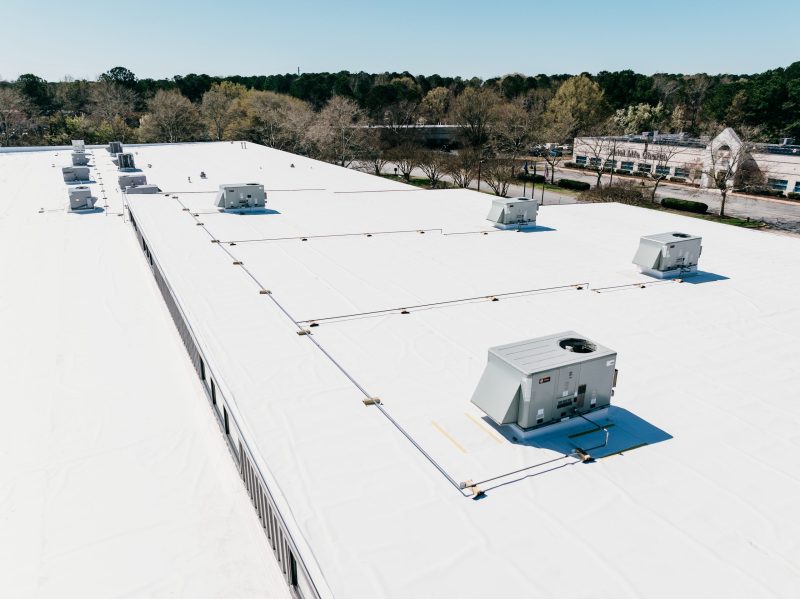
The waterproof layer in a roofing system that protects the building from water intrusion and reflects sunlight, lowering energy costs. It’s usually the top layer of the roofing system and can be made of materials like TPO, PVC, EPDM, or modified bitumen.

Heat welded thermoplastic membrane

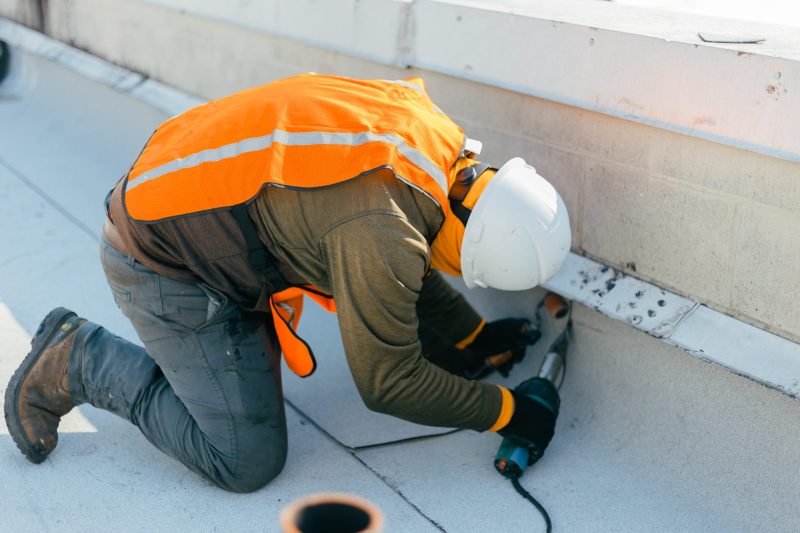
A type of white single-ply roofing membrane that’s sealed at the seams using hot air, creating a waterproof layer over the roof. It’s commonly used on flat or low-slope commercial buildings, since these roofs need to most protection from water infiltration.

EPDM (ethylene propylene diene monomer)

A black, gray or white rubber roofing membrane known for its long lifespan. It’s commonly used on flat or low-slope buildings and is typically glued down, mechanically fastened or ballasted, not heat-welded.

PVC (polyvinyl chloride)

A high-end type of heat-welded thermoplastic membrane that stands up well to oils and chemicals. It’s ideal for restaurants or industrial buildings for its extra resistance, though it usually costs more.

TPO (thermoplastic olefin)

A durable type of heat-welded thermoplastic membrane that reflects sunlight and helps reduce cooling costs. It’s a cost-effective option for flat roofs but may not perform as well as PVC in harsh environments.

End cap

A metal cap that seals the open end of gutters, flashings, or panels. End caps prevent water from spilling and protect roof edges from corrosion or leaks.

Soldered joint

A watertight joint created by joining metal roofing or flashing components together. Soldered joints provide long-lasting, durable seals against water infiltration.

Parapet wall

The short wall that extends above the roofline, often around the roof’s edge, to provide safety, block wind, and in some cases help manage water drainage. In roofing, parapet walls are usually capped with coping to keep water from seeping into the wall structure.

Retro drain

A roof drain retrofit designed to fit inside existing piping without major demolition. Retro drains are cost-effective solutions for improving drainage on older roofs.